
Open CDC Discontinuation in India: New Rules by DGS, Eligibility Criteria, and Information for Seafarers
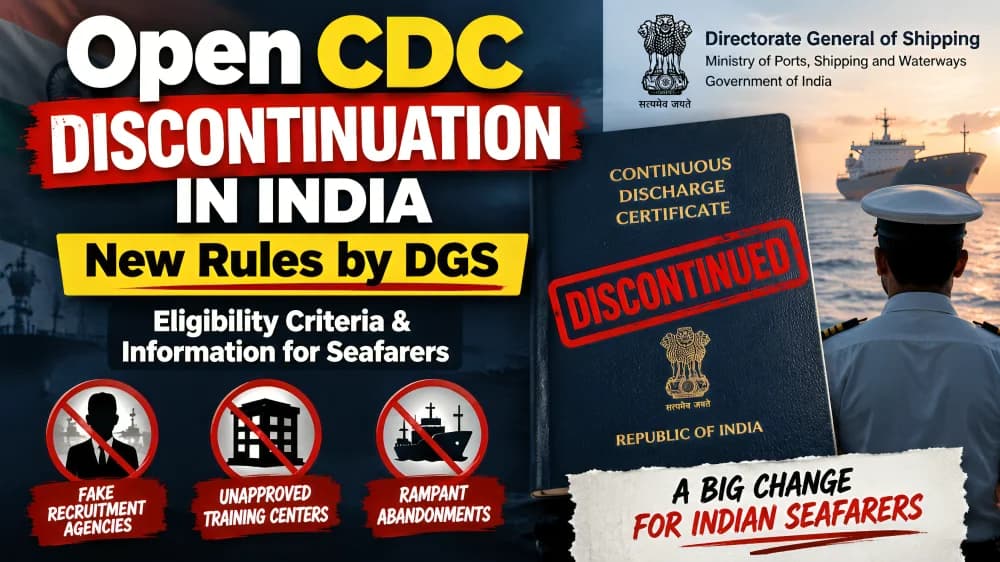
The Directorate General of Shipping (DGS) of Ministry of Ports, Shipping and Waterways has announced DGS Order 12 of 2026 to discontinue the direct issue of Continuous Discharge Certificates (CDCs) through only the five core STCW modular courses. This regulation brings a significant change in the maritime sector, which will counter fake recruitment agencies, unapproved training centers, and rampant abandonments of Indian seafarers aboard foreign open registry vessels.
What Does an Open CDC Holder Mean?
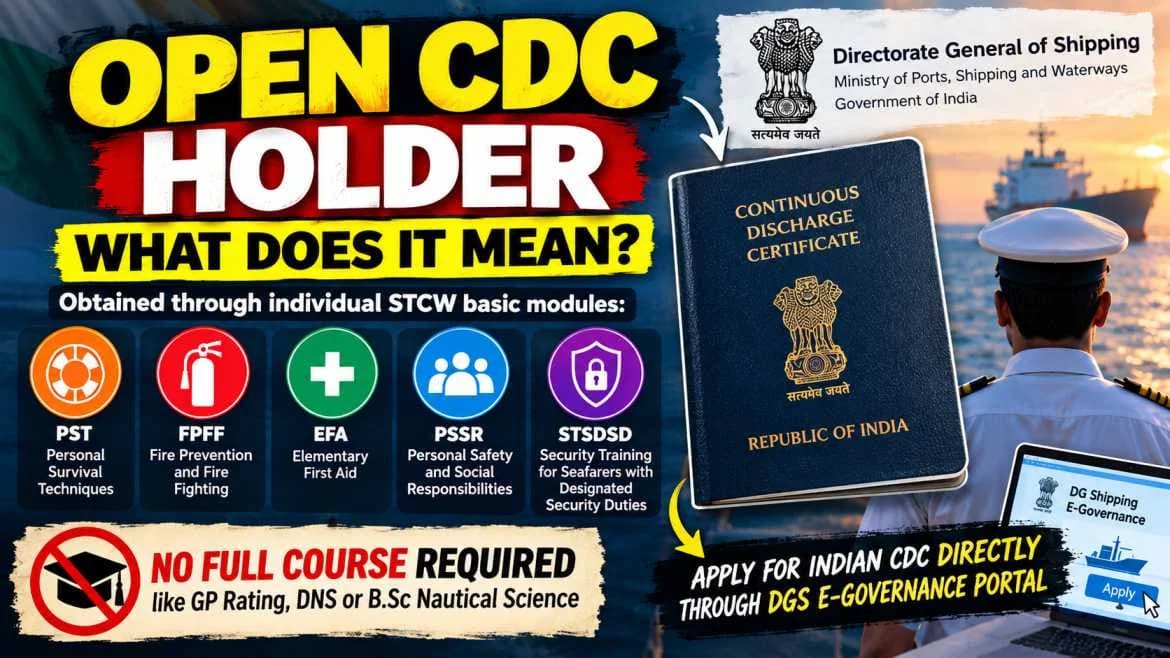
Open cdc holder meaning in the traditional context referred to a person who had an Indian Continuous Discharge Certificate but did not undergo a full course in a training institution such as GP Rating, DNS, and B.Sc Nautical Science. Open cdc holder was achieved through taking separate modules for safety training that fall under the STCW convention:
Personal Survival Techniques (PST)
Fire Prevention and Fire Fighting (FPFF)
Elementary First Aid (EFA)
Personal Safety and Social Responsibilities (PSSR)
Security Training for Seafarers with Designated Security Duties (STSDSD)
After the completion of the basic courses, open cdc holders applied for their Indian CDC directly through the application portal using DG Shipping e-governance platform.
Open CDC Holder for Merchant Navy: The Ground Reality
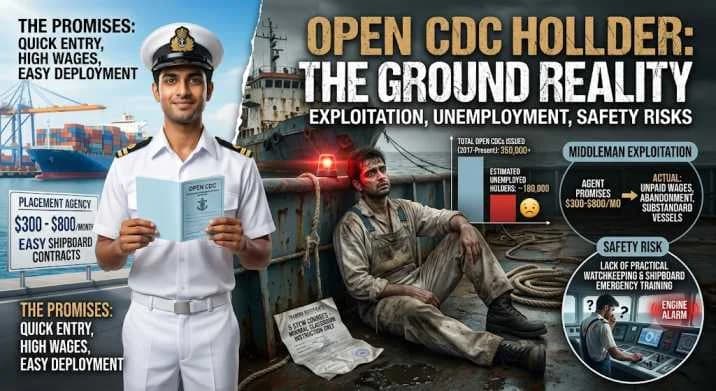
While introduced under the Merchant Shipping (CDC) Rules, 2017 to facilitate straightforward maritime entry, the pathway faced severe market distortions. Over 350,000 candidates secured CDCs via this 5-course route, leaving nearly 180,000 without a single shipboard contract.
Open cdc holder salary: Unofficial intermediaries frequently promised monthly wages between $300 and $800 to freshers. In practice, many candidates were placed on uninspected, sub-standard coastal or offshore flag-of-convenience vessels with delayed or unpaid wages, or were completely abandoned without compensation.
Safety Risks: Minimal classroom instruction failed to equip ratings with fundamental watchkeeping, workshop, or shipboard emergency procedures, leaving them unprepared for modern automated vessels.
Why Has Open CDC Been Discontinued for Seafarers?
Under DGS Order 12 of 2026, the rationale behind discontinuing open cdc for seafarers was due to important issues of welfare and regulation:
Agent Frauds: Intermediaries took advantage of candidates from distant economically weak areas, promising them placements, and demanding exorbitant charges for little safety training
Increase in Abandonments Worldwide: Information released by the International Transport Workers' Federation (ITF) showed that Indian seafarers are the highest in the number of abandoned crews around the globe, surpassing 1,125 individuals in the year 2025 alone. A good portion of these seafarers had never worked before and had their CDCs only through five basic STCW courses
Quality Standards: In international maritime services, it is necessary to have proper pre-sea training along with improved competency levels as per MLC and IMO standards.
Open CDC New Rules: Permitted Pathways for Indian CDC Issuance
Under the Open CDC new rules, maritime training institutes are barred from advertising or providing standalone 5 basic STCW modules as a qualifying path toward obtaining a CDC. Candidates can no longer directly utilize an Open CDC apply link unless they belong to one of the approved regulatory streams:
Approved Category | Specific Mandatory Requirements |
Pre-Sea Trainees | Completion of DG Shipping-approved residential Pre-Sea Training courses (e.g., GP Rating, CCMC, Deck Cadet, Engine Cadet) + 5 basic STCW courses. |
Agniveer Candidates | Valid Agniveer discharge certificate + 5 basic STCW courses. |
Hospitality Personnel | Degree/Diploma in Hotel Management + DG-approved Orientation Course for Catering Personnel (OCCP) + 5 basic STCW courses. |
Cruise Line Professionals | Engaged through DG-approved cruise Recruitment & Placement Services (RPSL); CDC restricted solely to cruise/passenger vessels + 5 basic STCW courses. |
Ex-Indian Navy Personnel | Retired Indian Naval officers or sailors with an authentic discharge certificate + 5 basic STCW courses. |
Certified Cooks & CoC Holders | Government of India recognized Cook CoC or Certificate of Competency + 5 basic STCW courses. |
Revised Entry Criteria, Fees, and Age Limits
To enhance rating competency and bridge operational gaps, the Directorate General of Shipping updated pre-sea parameters:
Open CDC Age Limit and GP Rating Expansion
The upper Open CDC age limit in India for standard DG-approved GP Rating courses has been officially raised from 25 years to 28 years.
Age relaxations for SC/ST candidates continue to apply as per existing Training Circular guidelines.
A 25% seat reservation is now active across all GP Rating batches for holders of 1-year trade diplomas (ITI) in fitter, mechanic, electrical, plumbing, welding (IACS certified), or computer trades.
Course Fees & Deadlines
Open CDC fee structure: Students used to pay ₹15,000 to ₹35,000 for individual STCW courses. However, aspirants have to be prepared to enroll in complete pre-sea maritime training programs (GP Rating, CCMC, or OCCP) that would cost from ₹1,50,000 to ₹4,50,000 at any DG-recognized maritime training institutions. Aspirants looking for course schedules and recognized maritime training institutions can refer to certified maritime training websites such as stcwcoursefinder.
Open CDC deadline date: The official deadline date for this change is August 1, 2026. Any application for CDC filed at Shipping Master offices before August 1, 2026, will fall into the old categories.
Key Takeaways for Current CDC Holders
Existing Documents Remain Valid: If you were issued an Indian CDC prior to August 1, 2026 under the Merchant Shipping (CDC) Rules, 2017, your document remains fully valid. You do not need to reapply.
Avoid Unregistered Agents: Maritime aspirants should verify training institutes directly on the DG Shipping master database or search tools like stcwcoursefinder, ensuring programs align with pre-sea certification standards rather than standalone, non-qualifying STCW packages.